


Why Specific Post Engagement Beats Average Engagement for Athlete Influencer Campaigns
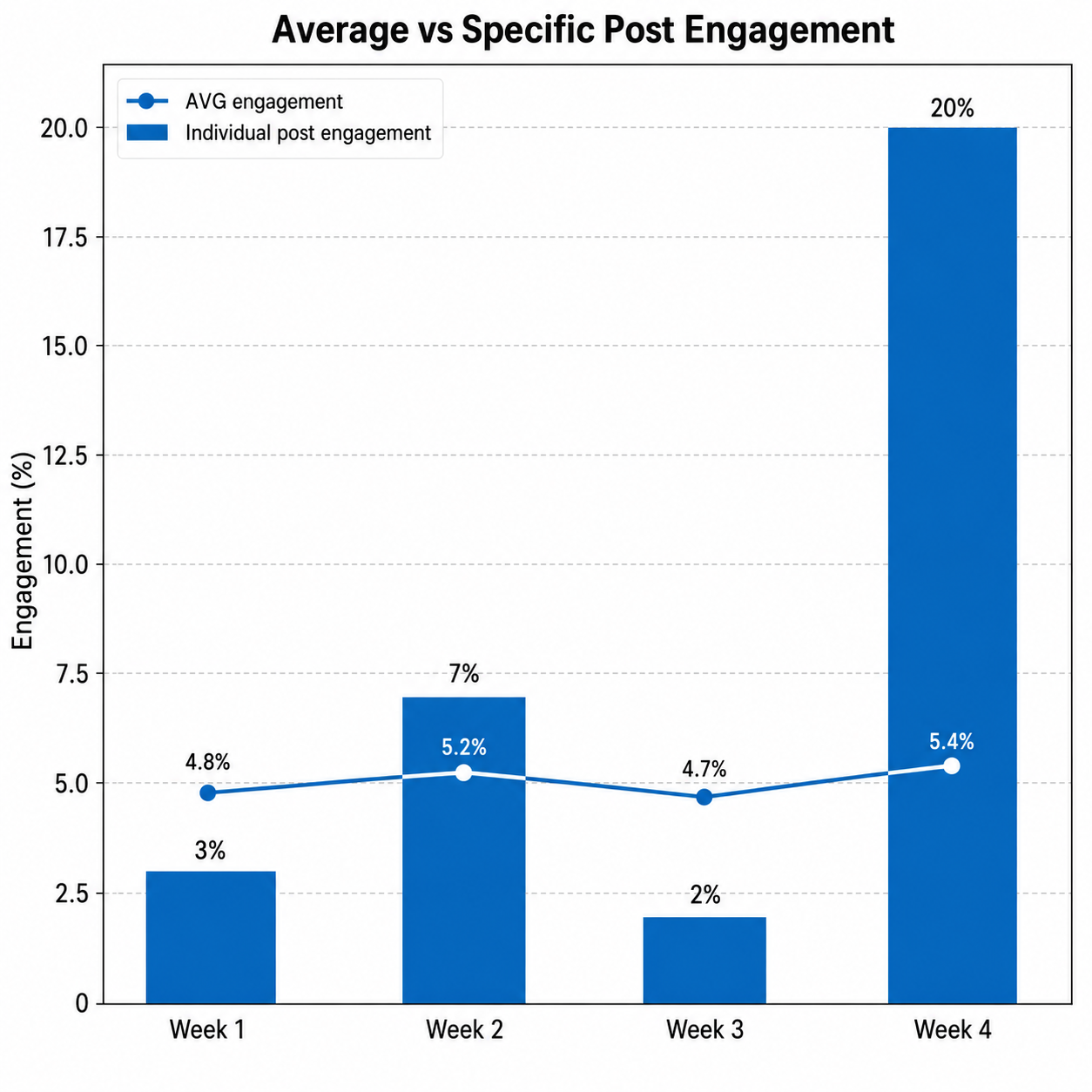
Specific post engagement is often more useful than an athlete’s average engagement rate because it shows how that athlete’s audience responds to the exact type of content your campaign needs. Average engagement can help with early screening, but post-level performance gives you a clearer read on message fit, content format, audience relevance, and campaign potential.
Why can average engagement mislead brands?
Average engagement rate compresses an athlete’s entire feed into one number. That can hide the difference between casual lifestyle posts, team updates, training clips, product mentions, and campaign-style content.
For brands, that matters because you are not buying an athlete’s average post. You are asking a specific athlete to create a specific message for a specific audience. If their audience engages strongly with training content, beauty routines, wellness products, campus life, or local restaurant recommendations, that context is more actionable than a blended profile-wide average.
A useful average can still help you filter obvious mismatches. But it should not be the final decision point.
What is specific post engagement?
Specific post engagement is the engagement tied to a defined content subset: a single post, a recent group of posts, or posts that match a campaign category, format, or audience need.
For athlete influencer marketing, that could mean looking at:
- Recent posts about training, recovery, nutrition, beauty, fashion, events, or lifestyle
- Reels or TikToks rather than static images
- Posts with products in use rather than generic personal updates
- Content where the athlete explains, demonstrates, or recommends something
- Campaign deliverables that resemble the brand’s planned creative
This helps you answer a better question: not “is this athlete generally engaging?” but “does this athlete’s audience respond to content like the campaign we want to run?”
When should brands still use average engagement rate?
Use average engagement rate as a screening metric, not as the whole evaluation.
Average engagement is helpful when you need to compare a large pool quickly, identify outliers, or understand whether an account has a baseline level of audience interaction. It is less helpful when you are deciding whether a creator is a strong match for a particular product, audience, or deliverable.
The better workflow is:
- Use average engagement to screen the initial pool.
- Review recent post-level performance.
- Compare posts that resemble your planned campaign.
- Look at the audience, format, and message behind the strongest posts.
- Track the actual campaign deliverables after launch.
How does post-level engagement improve athlete selection?
Post-level engagement helps you match athletes to the campaigns they are most likely to make believable.
An athlete with an ordinary account-level average may still be an excellent fit if their audience over-indexes on the exact content category your brand needs. A runner may perform especially well on race-day prep. A volleyball player may drive strong engagement around beauty, wellness, or team lifestyle content. A local athlete may outperform broader creators for restaurant, event, or campus activation campaigns.
This is especially important for NIL Deals and athlete influencer marketing because audience trust is often contextual. The athlete’s credibility depends on the message feeling natural to their routine, sport, community, and personality.
What does the wuv.u Beauty campaign show?
Our wuv.u Beauty case study is a useful example of why campaign-specific engagement matters. In that athlete-led product seeding campaign, 31 student-athletes created organic social content around beauty and lifestyle moments such as race day, practice prep, media day, and everyday routines.
The campaign generated 8,495 organic impressions and 761 engagements, producing an 8.95% average engagement rate with zero paid media spend. The campaign also delivered an engagement rate 448% higher than the industry average, with top-performing creators reaching engagement rates between 9% and 13.5%.
That proof point matters because the outcome was not just about choosing athletes with attractive profile averages. It was about matching the product to athletes whose real content moments could make the brand feel relevant and authentic. You can review the full public story here: wuv.u Beauty’s athlete-led product seeding campaign with 448% higher engagement.
What should brands measure after a campaign goes live?
Once a campaign is active, brands should evaluate the actual deliverables, not just the athlete profiles selected before launch.
Useful post-level metrics include:
- Engagement rate on each campaign post
- Impressions and reach
- Saves, shares, comments, and link actions where available
- Format performance across Reels, TikToks, Stories, and static posts
- Differences by athlete, sport, school, audience, or content angle
- Which creative prompts produced the strongest response
This turns campaign reporting into a learning loop. Instead of asking whether athlete influencer marketing “worked” in the abstract, you can see which athletes, content types, and messages created the strongest response.
How do we support post-level campaign evaluation?
Our point of view is simple: athlete selection should be based on the content that matters most to the campaign, not just a profile-wide average.
We help brands look beyond account-level averages by giving them more context on recent athlete content and the metrics attached to each post. That helps teams compare creators by actual content fit and then use campaign reporting to understand which deliverables performed best.
For brands managing influencer marketing at scale, this matters because more data is not automatically better. The right data is the data that helps you make a better campaign decision.
What is the practical takeaway?
If you are choosing athlete influencers, average engagement should be the start of the conversation, not the end of it.
A strong campaign evaluation should ask:
- Does this athlete’s audience engage with content like our planned campaign?
- Which recent posts are most relevant to our product or category?
- Are the strongest posts tied to a format we can actually use?
- Does the athlete’s voice make the message feel credible?
- How will we measure the campaign posts after launch?
Specific post engagement gives you a clearer answer to those questions than a generic average.
In Summary
- Average engagement rate is useful for early screening, but it can hide important context.
- Specific post engagement shows how an athlete’s audience responds to the type of content your campaign actually needs.
- Post-level data helps brands match athletes to products, formats, and audiences more precisely.
- Our wuv.u Beauty campaign shows how athlete-led content can outperform industry engagement benchmarks when the product, audience, and creator context fit.
- The best athlete influencer campaigns use post-level performance before selection and after launch.


