


State-by-State NIL Regulations for High School
Updated August 2026: As of August 2026, this report is accurate based on the latest state-association rules and sourced changes reviewed for this update. High-school NIL rules can change during the school year, so verify the linked governing-association or legislative source before signing or activating a deal.
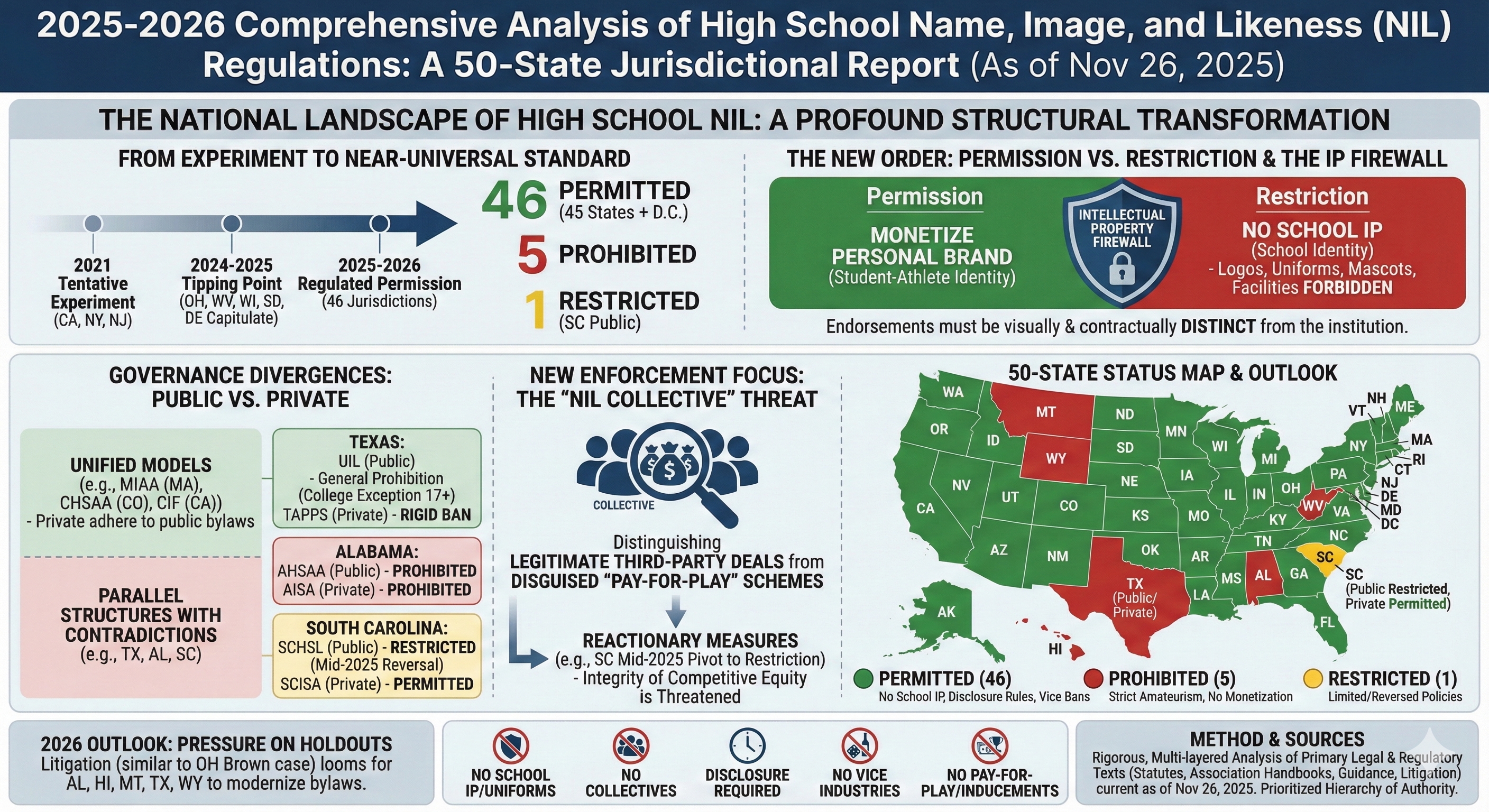
If you’re a high school athlete thinking about NIL deals, the rules depend heavily on where you live, which association governs your eligibility, and what school you attend. Nearly every U.S. jurisdiction now provides either a high-school NIL pathway or a limited NIL framework, but “allowed” does not mean the same thing everywhere. Some associations permit immediate compensation, Texas allows only a restricted pathway for qualifying older athletes, and several states remain prohibited or association-specific. This guide explains the common rules and provides a detailed table for all 50 states plus Washington, D.C.
What is NIL for high school athletes – and why should you care?
NIL in plain language
“Name, Image, and Likeness” (NIL) is your personal brand:
- Name – what you’re known by on a roster or social media
- Image – photos and videos of you
- Likeness – anything that represents you, including graphics, signatures, or personal branding
An NIL deal is an agreement where you receive something of value, such as cash, products, travel, or services, in exchange for a legitimate use of your NIL. Common examples include:
- Social media posts or user-generated content for brands
- Appearances at camps, clinics, signings, or events
- Autographs, merchandise, modeling, or advertising
- Promo codes, affiliate links, subscriptions, or digital products
How NIL turns high school athletes into “athlete influencers”
Where their governing rules permit it, high school athletes can operate as athlete influencers:
- Brands can pay for legitimate influencer marketing and endorsement activity
- Athletes can build and monetize audiences on TikTok, Instagram, YouTube, and other platforms
- Athletes can build professional habits and a marketable personal brand before college
High-school NIL rules are often tighter than college rules. Compensation, disclosure, school intellectual property, recruiting, and school or booster involvement can each be treated differently by the athlete’s governing association.
What changed between 2021 and August 2026?
High-school NIL expanded quickly after the college-level shift, but the current landscape is not a simple state-law map:
- Early adopters such as California, New York, and New Jersey established individual high-school NIL pathways
- Florida adopted a high-school NIL framework in 2024, while West Virginia and Wisconsin added frameworks for the 2025–26 school year
- Ohio approved high-school NIL in November 2025, although legislation introduced in 2026 seeks to prohibit it
- Michigan expanded individual Personal Branding Activities in January 2026, including endorsements, appearances, advertising, and merchandise, while continuing to restrict collectives and school involvement
- Texas created a limited path for certain prospective college athletes age 17 or older, but UIL athletes cannot execute ordinary third-party NIL agreements until they have exhausted eligibility in the applicable sport
- The clearest current outright-prohibition states are Alabama, Indiana, Mississippi, and Wyoming; Hawaii and Montana require a current association-level check rather than an unsupported statewide label
Which states let high school athletes sign NIL deals?
The four big buckets: Permitted, Restricted, Prohibited, and Mixed
For this guide, the national picture is organized into four categories:
- Permitted – The athlete can receive bona-fide NIL compensation while retaining eligibility, subject to association and school rules
- Restricted / conditional – Contracting, payment, age, college commitment, or another condition materially limits the opportunity; Texas belongs here
- Prohibited – Amateur-status rules prevent paid NIL tied to athletic reputation while eligibility is active
- Mixed / association-specific – Rules differ materially by governing association, league, or school
Specific examples as of August 2026:
- Permitted: California, Florida, Michigan, New York, Ohio, West Virginia, and Wisconsin, subject to their governing rules
- Prohibited: Alabama, Indiana, Mississippi, and Wyoming are the clearest current examples
- Restricted / conditional: Texas allows certain age-17-or-older prospective college athletes to sign qualifying agreements, but UIL restrictions prevent ordinary third-party agreements from being executed while sport-specific eligibility remains
- Mixed / association-specific: Hawaii, South Carolina, North Carolina, and other states where the athlete’s actual association materially changes the answer
Why your governing association and school matter
High-school NIL is generally governed by the association that controls the athlete’s eligibility, not simply by the state where the athlete lives. Public, charter, parochial, and independent schools can fall under different associations, and state law may supplement or override an association rule.
That means two athletes in the same city can face different NIL rules. Before pursuing a deal, identify all three:
- Your state’s applicable law or regulatory overlay
- The governing association or league that controls your eligibility
- Your school’s own disclosure, intellectual-property, facility, and conduct rules
For a reliable eligibility decision, use the hierarchy state → governing association → school.
What rules do most states put on high school NIL deals?
Most permitted frameworks follow an individual opportunity model. An athlete may earn market-value compensation for a legitimate use of their own NIL, but the deal cannot be pay-for-play, a recruiting or transfer inducement, or an unauthorized commercial use of school identity. The details still vary by association.
NIL permission and school intellectual property are separate questions
Can the athlete be paid? and Can the athlete use the school’s uniform, logo, facility, footage, or social account? are separate questions.
- NIL permission does not automatically give a brand rights to school trademarks, uniforms, mascots, facilities, footage, or other intellectual property
- Those rights may require separate written school authorization even when the athlete’s underlying NIL activity is permitted
- Some associations impose broader restrictions, so confirm the current rule instead of assuming one nationwide “no logos” standard
Brands are paying for the athlete’s NIL. Any use of school identity should be cleared separately with the school and governing association.
Limits on the types of brands you can promote
Many associations restrict sponsorship categories that conflict with school or interscholastic-athletics policies. Common examples include:
- Alcohol, tobacco, and vaping products
- Gambling, sports betting, or casinos
- Cannabis, banned substances, or performance-enhancing drugs
- Weapons, sexually explicit content, or other age-inappropriate categories
These examples are not an exhaustive nationwide list. Use the athlete’s current association policy and school standards for the final check.
Disclosure, contracts, recruiting, and collectives
Common additional rules include:
- Disclosure – Some associations require the athlete or parent/guardian to report an NIL agreement to the school or association. The deadline and recipient vary, so check the current policy
- No pay-for-play – Compensation cannot be tied to statistics, awards, team participation, winning, or athletic performance
- No recruiting or transfer inducements – NIL cannot be used to purchase enrollment, continued attendance, or a transfer decision
- Limits on school, booster, and collective involvement – The scope varies by association; Michigan, for example, permits individual opportunities but excludes collectives and school-connected facilitation
Bottom line: a permitted NIL deal must compensate the athlete for a legitimate commercial use of their NIL, not for choosing a school or performing a certain way.
How do public and private school NIL rules differ?
Association-specific states you should watch
Public versus private is a useful first question, but it is not a complete rule. Association membership is the more reliable unit of analysis.
- Georgia: GHSA includes public and private schools, while many independent-school athletes operate under separate GIAA rules
- Hawaii: HHSAA operates over multiple interscholastic leagues, so athletes should confirm the rule of the league governing their school
- North Carolina: Public-school eligibility involves current state-board and NCHSAA requirements, while many independent schools follow NCISAA rules
- South Carolina: SCHSL and SCISA rules can differ materially, so an opportunity available at one school may not be available at another
- Texas: UIL rules govern most public-school athletes, TAPPS may govern private-school athletes, and state law adds a separate prospective-college-athlete framework
What that means for you as a recruit or transfer
If you’re considering transferring schools or comparing public, charter, parochial, or independent schools:
- Ask which association or league actually controls athletic eligibility
- Ask whether that current rule permits receiving NIL compensation now, permits only future agreements, or prohibits paid NIL
- Confirm whether the school has separate disclosure, branding, facility, or conduct requirements
- Understand that changing schools can change your NIL options even if you never leave the state
State-by-state NIL rules for high school athletes (August 2026)
How to read this NIL table
- Permitted – The athlete can receive legitimate NIL compensation while retaining eligibility, subject to the stated rules
- Restricted / conditional – A material condition limits contracting or payment
- Prohibited – Paid NIL tied to athletic reputation can jeopardize active high-school eligibility
- Mixed / association-specific – The answer depends on the athlete’s governing association, league, or school
- Primary source – The official association or legislative source to check before signing
Important: As of August 2026, this report and table are accurate based on the official rules and sourced changes reviewed for this update. Rules can change during the school year. Eligibility is ultimately governed by the athlete’s current association and school, so verify the linked source before signing or activating an NIL deal.
What should you do before signing your first NIL deal?
Build a simple game plan with your parents or guardians
Before you jump into NIL deals:
- Talk with a parent or guardian about taxes, scams, privacy, and long-term consequences
- Decide who will review contracts and help you reject bad or non-compliant offers
- Keep a written list of deliverables, post dates, appearances, disclosure steps, and payment obligations
Check your eligibility and school rules first
Always confirm:
- Which governing association or league controls your eligibility?
- Can you enter an NIL contract, and can you receive payment while you remain eligible?
- Does the association or school require disclosure, and what is the current deadline?
- Do you need separate permission to use school names, marks, uniforms, facilities, footage, or social accounts?
If you sign or activate a non-compliant deal, you could lose eligibility even if the brand intended to follow the rules.
Treat your NIL deals like a business, not a side hustle
For high school athlete influencers, the most valuable things you can do are:
- Protect your eligibility – no pay-for-play or recruiting inducements; get school-IP permission when needed
- Protect your reputation – choose brands that align with your values, age, and future goals
- Protect your future recruiting – keep contracts, disclosures, permissions, and deliverables organized
NIL can be a powerful way to learn business, build your brand, and support your family, but only if the deal fits the rules governing your current school eligibility.
In Summary
- Nearly every U.S. jurisdiction now provides either a high-school NIL pathway or a limited framework, but “allowed” varies by association and school
- Alabama, Indiana, Mississippi, and Wyoming are the clearest current outright-prohibition states in the August 2026 review
- Michigan now permits individual NIL and Personal Branding Activities; its old “Prohibited” label is no longer accurate
- Texas is Restricted / conditional: certain prospective college athletes age 17 or older may sign qualifying agreements with postsecondary institutions, while UIL restrictions prevent ordinary third-party agreements from being executed before sport-specific eligibility is exhausted
- Hawaii and Montana require current association-level verification rather than an unsupported categorical statewide label
- NIL permission does not automatically grant rights to school trademarks, uniforms, facilities, footage, or other intellectual property
- Before signing, identify the athlete’s state overlay, governing association, and school rules; then confirm disclosure, payment, school-IP, recruiting, and collective restrictions
- Even in “permitted” states, NIL deals almost always require a clear separation from school identity – no school logos, mascots, uniforms, or facilities in your content.
- Public and private schools sometimes follow different NIL rules, especially in states with dual-governance models like Georgia, South Carolina, Texas, Virginia, and North Carolina.
- Common restrictions across states include bans on pay-for-play, recruiting inducements, NIL collectives that look like booster clubs, and partnerships with vice industries such as gambling, alcohol, or tobacco.
- Before signing NIL deals, high school athletes should confirm their state and school policies, involve parents or guardians, and treat NIL like a real business to protect both eligibility and future college opportunities.


