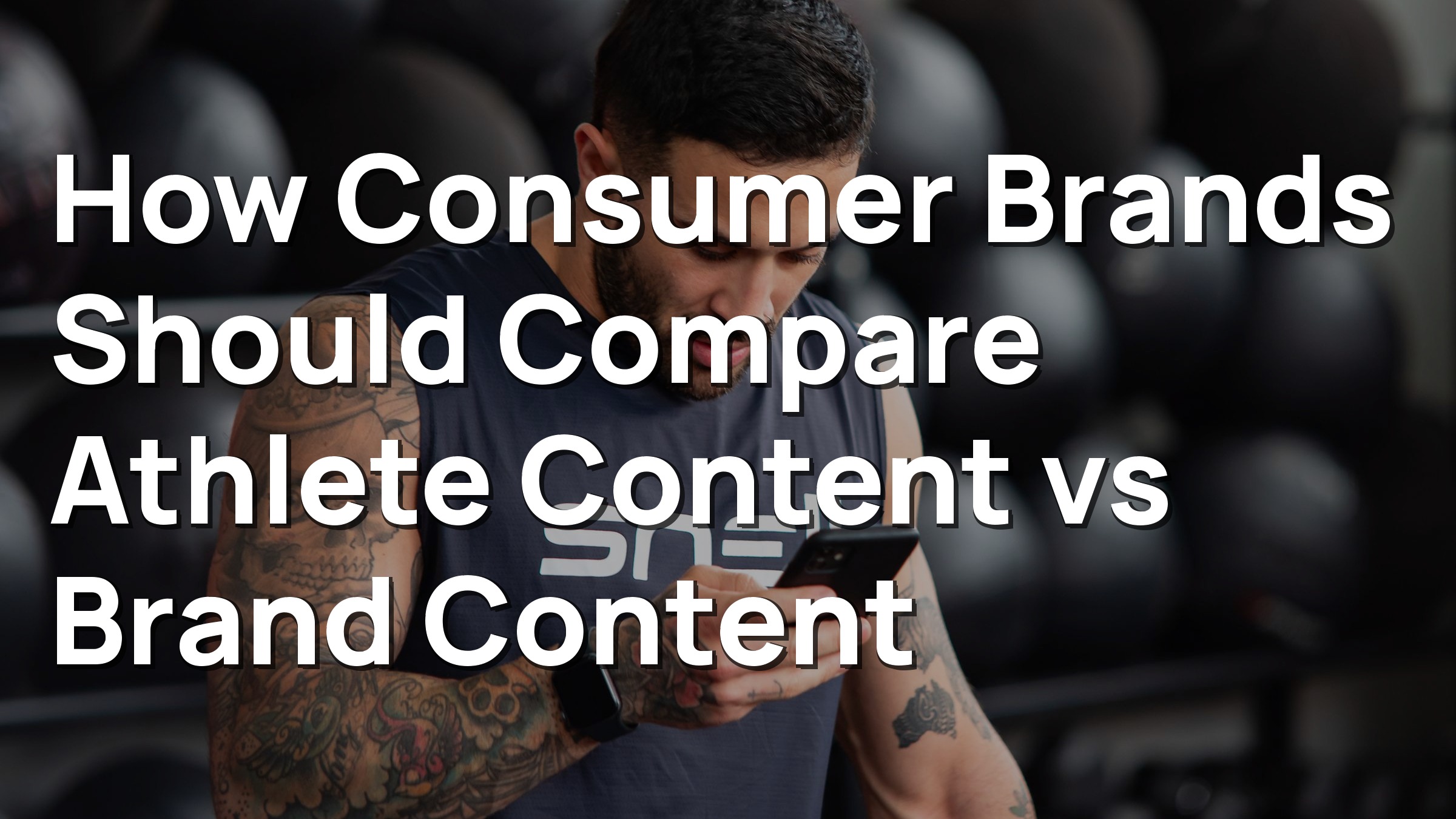
How Consumer Brands Should Compare Athlete Content vs Brand Content
Athlete-based content often delivers higher engagement than regular brand content when the creative is athlete-led, authentic to the creator’s routine, and measured on specific posts, not vanity averages. Brand-created content still wins when you need tight message control, regulated claims, or owned-channel polish. We built MOGL so you can compare those lanes on engagement, ROI, scalability, and campaign risk and pick the stronger model for each objective.
If you lead marketing for a consumer brand, you already feel the tension. Studio creative looks on-brand. Athlete posts feel native in the feed. The useful question is not which one is “better” forever. It is which model fits the job, and how you stop underperforming when you mix them without a decision framework.
What athlete content and brand content actually mean
Athlete content is creative the athlete leads: their voice, their setting, their audience relationship. Product shows up inside a real routine (getting ready, training, campus life, travel), not as a bolted-on logo moment. In practice that is how athlete influencers earn trust. Fans already follow the person for sport and lifestyle, so the post feels like a recommendation inside a relationship, not an interruption. NIL deals can sit in this lane when the student-athlete owns the story and the brand stays inside the brief’s guardrails.
Brand content is creative your team (or agency) leads: controlled messaging, controlled production, owned channels, and clear claim language. It can still feature athletes as talent, but the brand owns the script and the look. That lane is right for retail toolkits, regulated education, and launches that must match packaging and legal review word for word.
Both can be excellent. They fail when you treat them as interchangeable. Athlete content measured like a TV spot, or brand content forced to “feel organic” without giving the creator room, usually underperforms. Write the lane on the brief before you hire talent so athlete influencers and brand producers are not solving different jobs with the same asset list.
Compare on engagement first
Engagement is where athlete-led creative usually pulls ahead, especially with Gen Z and campus-adjacent audiences who trust peers more than polished ads. That does not mean every athlete post wins. It means the format and voice are closer to how people already consume social, so the ceiling for comments, saves, and shares is often higher when the brief protects authenticity.
Judge engagement at the post level. Average engagement across a roster hides the posts that actually moved people. Specific saves, shares, comments, and completion rates tell you whether the story landed. For more on that measurement habit, see why specific post engagement beats average engagement.
Brand content can still win attention when the production value is the point (product launch films, retail lookbooks, regulated education). It rarely wins when the brief asks for “UGC energy” while keeping a rigid script.
Public proof: wuv.u wanted authentic, social-first athlete storytelling rather than overly polished branded creative. Through a 31-athlete product-seeding campaign on Instagram Reels and TikTok, the program delivered 8,495 organic impressions, 761 engagements, an 8.95% average engagement rate (448% higher than the industry average), and top creators between 9% and 13.5% ER, with zero paid media spend. That is what athlete-led routine content can do when engagement is the job.
Compare on ROI, not vibes
ROI is where teams get fuzzy. Athlete content is not automatically cheaper or more profitable. It is often more efficient on attention and trust per dollar when you count organic engagement, reusable UGC, and paid amplification of posts that already worked.
Brand content can show clearer short-term ROI when the only job is a controlled claim, a retail calendar, or a performance landing page with a fixed message. The cost of production and media is usually higher, but the message risk is lower.
A fair ROI comparison asks:
- What outcome are we buying (engagement, leads, traffic, content library, brand lift)?
- What did we spend on talent, production, product, and media?
- Which assets can we reuse with rights attached?
- Are we scoring organic and paid with the same honesty?
Build a side-by-side for one campaign objective, not a permanent winner. If engagement is the KPI, athlete content’s cost per meaningful interaction often looks stronger because the creator already brings distribution and trust. If a regulated claim or retail-ready asset is the KPI, brand content’s higher production cost can still be the cheaper path because revisions and legal cycles are designed for that control.
Do not invent a single “athlete always wins” ROI claim. Use public proof when you have it, and keep customer-specific numbers inside claim boundaries for human review.
Compare on scalability
Scalability is about whether the model survives the second flight.
Athlete content scales when you can brief many creators, collect deliverables, approve at volume, attach rights, and measure without restarting email chains every week. A micro-roster or marketplace model can produce a lot of authentic assets fast. It breaks when every athlete is a one-off sponsorship with no shared brief, status, or measurement.
Brand content scales inside your existing production machine: templates, studios, agencies, brand guidelines. It breaks when you try to manufacture “authenticity” at volume without creators who already have audience trust.
If your roadmap is “10 posts this month, 100 next quarter,” prioritize the operating system behind athlete content (briefs, approvals, rights, reporting). If your roadmap is “one flagship film and a retail toolkit,” brand content’s production machine may be the right scale path.
A practical test: can a new teammate see status for every asset without hunting Slack? If not, you do not have a scalable athlete content system yet, even if last month’s posts looked great. For marketplace-style underperformance patterns to avoid, see how consumer brands can improve athlete influencer marketplace campaign performance.
Compare on campaign risk
Campaign risk is the quiet decision criteria most decks skip.
Athlete content risk clusters around: off-brief posts, disclosure misses, usage-rights gaps, and uneven quality across a roster. You reduce that risk with clear briefs, review paths, disclosure rules, and rights captured before anything ships. You increase that risk when you over-script athletes into brand spokespeople and then act surprised when the feed rejects the post.
Brand content risk clusters around: low trust, high cost, and creative that looks like every other ad in category. You reduce that risk with strong creative craft and honest testing. You increase that risk when you assume polish alone creates belief.
Neither lane is “safe.” They fail differently. Pick the failure mode you can manage.
When athlete content should win the brief
Choose athlete-generated content when:
- Engagement and social proof are the primary outcome
- The product fits a real athlete or campus routine
- You can give creators room on format, tone, and story within clear goals
- You want a reusable UGC library for organic and paid
- You will measure specific posts, not roster averages
That is the lane wuv.u ran: seeding into everyday routines, creator-first storytelling, and engagement efficiency without paid spend. If your next flight is built around athlete influencers and NIL deals, start here. Give them a clear outcome, disclosure rules, and usage rights, then protect the authenticity that makes the engagement bet work. If you cannot leave room for their voice, you are already sliding into brand content with an athlete face, and you should score it that way on the comparison.
When brand content should win the brief
Choose brand-created content when:
- Claims, legal, or regulated categories need tight control
- The hero asset must match retail, packaging, or broadcast standards
- You need a single owned-channel narrative across markets
- Athlete involvement is talent inside a brand-led production, not a creator-led post
In those cases, athletes can still appear. The model is brand content with athlete talent, not athlete content with a brand cameo. Keep athlete influencers in the frame if they add credibility, but do not pretend a tightly scripted studio day is the same as creator-led social. Your comparison stays honest when the brief labels the lane correctly and your review path matches the control you actually need. If legal or retail standards own the final cut, brand content is the right call even when the face on camera is an athlete.
How to run the comparison without politics
Use a simple scorecard before the next campaign kickoff:
- Objective: engagement, control, content volume, or paid efficiency?
- Engagement bet: post-level authenticity vs polished message?
- ROI bet: what costs and reuse rights are in scope?
- Scale bet: many creators with shared ops, or one production machine?
- Risk bet: which failure mode can your team manage this quarter?
Write the answers down. Then choose the lane (or a sequenced mix: athlete content to earn attention, brand content to lock the claim). Treat athlete influencer marketing like a media channel with briefs, rights, approvals, and reporting, not a one-off endorsement. That operating discipline is how consumer brands turn athlete partnerships into repeatable performance instead of lucky posts. For the broader “core channel” framing, see how consumer brands can build athlete influencer campaigns into a core media channel.
Common underperformance drivers (and how to fix them)
Most weak athlete programs are not proof that athlete content “doesn’t work.” They are proof the comparison never happened:
- Treating athletes like billboards instead of media partners
- Over-scripting until the post sounds like a brand ad in a dorm
- Measuring vanity averages instead of specific post engagement
- Skipping rights and reuse, so winning creative cannot be amplified
- Mixing athlete and brand lanes mid-flight without a clear owner for each asset
Fix the decision criteria first. Then fix the operating system. Creative taste alone will not save a confused brief. When NIL deals and athlete influencers are hired without a lane choice, teams often blame the talent category instead of the missing comparison. Put engagement, ROI, scalability, and campaign risk on one page before kickoff, assign an owner for each asset type, and only then scale the roster.
In Summary
- Athlete-based content often wins engagement when it stays athlete-led and is measured post by post.
- Brand-created content still wins when control, claims, or owned-channel polish are the job.
- Compare both on engagement, ROI, scalability, and campaign risk before you default to polish.
- Use public proof like wuv.u’s 8.95% ER (448% above industry average) when engagement is the outcome.
- Write the decision down, then run the chosen lane with briefs, rights, approvals, and reporting.
FAQ
Does athlete-based content deliver higher engagement than regular brand content? Athlete-based content often delivers higher engagement than regular brand content when the creative is athlete-led, authentic to the creator’s routine, and measured on specific posts rather than vanity averages. Brand-created content still wins when you need tight message control, regulated claims, or owned-channel polish. Compare the two on engagement, ROI, scalability, and campaign risk before you default to polish.
When should consumer brands choose athlete content over brand creative? Choose athlete content when engagement and social proof are the primary outcome, the product fits a real athlete or campus routine, creators have room on format and tone within clear goals, and you will measure specific posts. Choose brand content when claims, legal, retail, or owned-channel standards require tight control.
What proof shows athlete-led content can outperform polished brand creative on engagement? In a published MOGL success story, wuv.u activated 31 student-athletes in a product-seeding campaign that prioritized authentic athlete storytelling over overly polished branded creative. Public results included 8,495 organic impressions, 761 engagements, an 8.95% average engagement rate (448% higher than the industry average), top creators between 9% and 13.5% ER, and zero paid media spend.
What criteria should brands use to compare athlete influencer marketing vs brand content? Use four decision criteria: engagement (post-level authenticity vs polished message), ROI (costs, reuse rights, and the outcome you are buying), scalability (many creators with shared ops vs one production machine), and campaign risk (which failure mode your team can manage). Write the answers down before kickoff.
If you want a clearer way to compare athlete content vs brand content on engagement, ROI, scalability, and campaign risk, talk with us about athlete influencer campaigns at mogl.online.